
 英语
英语 中文简体
中文简体

Content
- 1 The 7 Essential Juicing Rules Every Beginner Must Know
- 2 Rule 1: Match Your Juicer Type to What You Actually Want to Juice
- 3 Rule 2: Keep Your Fruit-to-Vegetable Ratio in Check
- 4 Rule 3: Prep Your Produce Properly Before It Hits the Juicer
- 5 Rule 4: Juice Vegetables First, Then Fruits and Soft Produce
- 6 Rule 5: Drink Your Juice Immediately — or Store It the Right Way
- 7 Rule 6: Clean Your Juicer Within 30 Minutes of Every Use
- 8 Rule 7: Rotate Your Ingredients and Avoid Juicing the Same Greens Every Day
- 9 Common Beginner Juicing Mistakes That These Rules Prevent
- 10 How to Build a Juicing Habit That Actually Sticks
- 11 Ingredients That Work Exceptionally Well in a Beginner Juicer
- 12 Understanding What Juicing Does — and Does Not — Do for Your Health
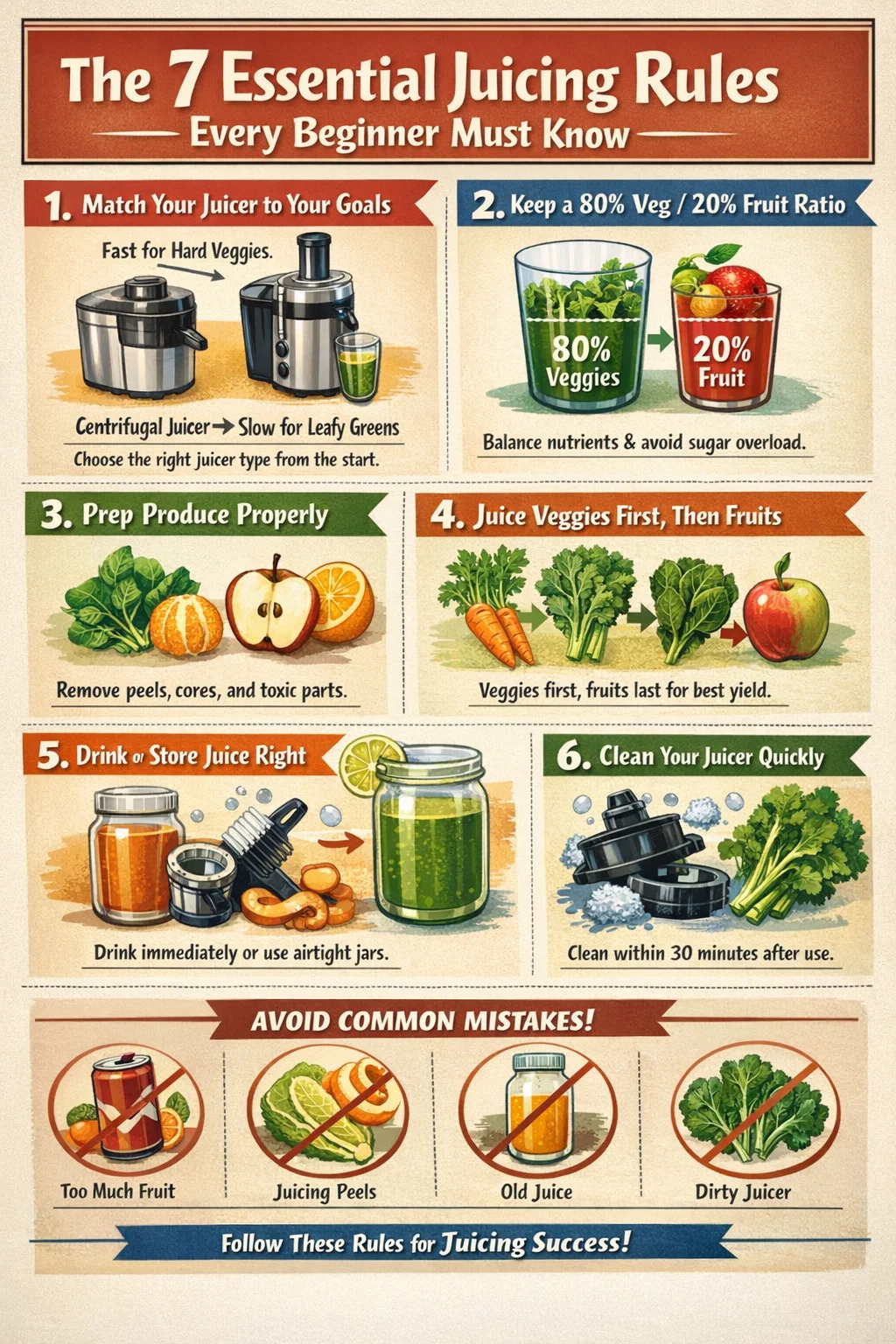
The 7 Essential Juicing Rules Every Beginner Must Know
If you just bought your first juicer and have no idea where to start, here is the short answer: drink your juice within 20 minutes of making it, always juice vegetables before fruits, and clean your juicer immediately after every use. Those three habits alone will save you from the most common beginner mistakes. The seven rules below build on that foundation, covering everything from ingredient ratios to storage, so you get the most nutrition — and the most enjoyment — out of every glass.
Juicing has a learning curve that nobody really warns you about. You buy a centrifugal or cold press juicer, toss in some apples and spinach, and wonder why the result tastes like lawn clippings or why the machine clogs after three carrots. Most of that frustration is completely avoidable. These rules come from the repeated experiences of people who have been juicing for years — not from vague wellness advice, but from the practical side of working with a real machine and real produce.
Rule 1: Match Your Juicer Type to What You Actually Want to Juice
Before any technique matters, the machine matters. There are two main categories of juicer available to beginners — centrifugal juicers and masticating (cold press) juicers — and confusing the two leads to poor results and wasted money.
Centrifugal juicers spin at 6,000 to 14,000 RPM, shredding produce and separating juice through a fine mesh basket. They work fast — most recipes take under two minutes — and they handle hard vegetables like carrots, beets, and apples particularly well. The tradeoff is heat and oxidation. Because the blades spin so quickly, they introduce air into the juice, which begins breaking down nutrients almost immediately. Studies comparing juicer types have found that centrifugal models can reduce vitamin C content by up to 30% compared to slow juicers when the juice sits for more than 15 minutes.
Masticating juicers — also called cold press juicers or slow juicers — operate at 40 to 100 RPM. They crush and press produce rather than shredding it, which preserves more enzymes, chlorophyll, and vitamins. They excel at leafy greens like kale, wheatgrass, and spinach, where centrifugal machines often produce dry pulp and minimal juice. The downside: they are slower, more expensive (typically $200–$500 versus $50–$150 for centrifugal models), and require more prep work because the feed chutes are narrower.
| Feature | Centrifugal Juicer | Masticating Juicer |
|---|---|---|
| Speed | Very fast (1–2 min) | Slower (3–5 min) |
| Best for | Hard fruits & vegetables | Leafy greens, wheatgrass |
| Nutrient Retention | Moderate | High |
| Typical Price Range | $50–$150 | $200–$500 |
| Noise Level | Loud | Quiet |
| Juice Shelf Life | Best within 20 min | Up to 72 hours |
If you mostly want to make quick morning juices using carrots, cucumbers, apples, and the occasional handful of spinach, a centrifugal juicer is perfectly adequate. If wheatgrass shots, heavy leafy green blends, or batch-prepping juice for the week are priorities, invest in a masticating model from the start. Buying the wrong type and then upgrading later doubles the cost.
Rule 2: Keep Your Fruit-to-Vegetable Ratio in Check
This is the rule that most beginners ignore and later regret. Fruit juice tastes great. Vegetable juice is an acquired taste. So beginners pile in apples, mangoes, and pineapple to make everything palatable — and end up drinking something with more sugar than a can of soda.
A 16 oz glass of pure apple juice contains roughly 39 grams of sugar and very little fiber (fiber stays in the pulp after juicing). For context, the American Heart Association recommends no more than 25 grams of added sugar per day for women and 36 grams for men. Even "natural" fruit sugar hits the bloodstream fast without fiber to slow absorption.
The widely recommended ratio for beginners who want to juice for health rather than just taste is 80% vegetables to 20% fruit. In practical terms, that might look like this for a 16 oz juice:
- 3–4 stalks of celery
- 1 medium cucumber
- 1 large handful of spinach or kale
- 1 small apple or half a lemon for taste
- A 1-inch piece of fresh ginger
Beginners who find pure vegetable juice unbearable can start at 50/50 and gradually shift the ratio over several weeks. Your taste preferences will adapt faster than you expect — most people find that after two to three weeks of regular juicing, they actually prefer less fruit sweetness.
Rule 3: Prep Your Produce Properly Before It Hits the Juicer
A juicer is not a garbage disposal. Feeding it improperly prepped produce is one of the fastest ways to clog the filter, burn out the motor, or get a juice full of bitter compounds that should have been removed first.
What to always remove before juicing
- Citrus pith and peel — The white pith of oranges, grapefruits, and lemons contains compounds called limonoids that turn juice intensely bitter. Always peel citrus before juicing, leaving just a thin layer of the colored zest if you want some citrus flavor.
- Apple and pear seeds — These contain small amounts of amygdalin, which breaks down into hydrogen cyanide during digestion. The amount in a few seeds is negligible for most adults, but it is still best practice to core them out.
- Rhubarb leaves — These are toxic. Only the stalks are safe to juice.
- Tough vegetable stems — Broccoli and cauliflower stems will juice, but they produce a strongly sulphurous taste that overwhelms everything else. Use the florets if you want to include them at all.
How to cut produce for your specific juicer
Centrifugal juicers typically have wide feed chutes (3 inches or more) that can accept whole apples or full cucumbers — a major convenience. Masticating juicers have narrower chutes and require produce to be cut into 1–2 inch pieces. Feeding chunks that are too large into a slow juicer will cause it to jam repeatedly and can strain the motor over time.
Wash everything, even if you plan to peel it. Bacteria and pesticide residue on the outer skin can transfer to the flesh during peeling or cutting. A simple soak in a mix of water and white vinegar (3:1 ratio) for five minutes, followed by a rinse, removes most surface contaminants effectively and costs almost nothing.
Rule 4: Juice Vegetables First, Then Fruits and Soft Produce
The order in which you feed produce through your juicer has a real effect on yield and juice quality — especially with a masticating juicer. Start with leafy greens, then move to harder vegetables, then finish with soft fruits or high-water produce like cucumber and watermelon.
Here is why the order matters: leafy greens like spinach, kale, and parsley are difficult for any juicer to process on their own. They tend to wrap around the auger in a slow juicer or stick to the filter basket in a centrifugal machine. By alternating them with denser vegetables — carrot, celery, beet — you use the firmer produce to push the greens through the mechanism, dramatically increasing the juice yield from each handful.
Finishing with a piece of apple, cucumber, or lemon serves two purposes: it flushes residual juice and pulp from the machine, and it adds a small burst of flavor at the end that mixes into the final glass. Think of it as a natural rinse cycle that also improves taste.
A practical loading order for a standard green juice might look like:
- A handful of kale or spinach (rolled into a tight ball to feed more easily)
- Two stalks of celery
- Another handful of greens
- One medium carrot
- A second handful of greens or parsley
- One apple or half a cucumber to finish
Rule 5: Drink Your Juice Immediately — or Store It the Right Way
Fresh juice starts losing nutritional value from the moment it is made. Oxidation — the same process that turns a cut apple brown — breaks down vitamins and enzymes rapidly once produce is juiced. Juice made with a centrifugal juicer should be consumed within 15–20 minutes for maximum nutrition. Cold press juice holds up significantly better, staying nutritious for up to 48–72 hours if stored correctly.
How to store juice when you have to
- Use an airtight glass container. Mason jars work well and are inexpensive. Plastic containers are porous and can leach chemicals into acidic juices over time.
- Fill the container to the very top. The less air space in the jar, the less oxidation occurs. If using a half-pint jar, fill it completely so the lid is touching the liquid.
- Add a squeeze of lemon. Lemon juice is naturally high in ascorbic acid (vitamin C), which acts as an antioxidant and slows the oxidation of other nutrients. Even a tablespoon helps extend freshness.
- Keep it refrigerated at 35–38°F (2–3°C). This temperature range slows bacterial growth and enzymatic breakdown without freezing the juice.
- Never freeze juice in glass. Liquids expand when frozen. Use BPA-free plastic freezer containers if you want to freeze batches, and leave headspace for expansion.
Batch juicing on weekends and storing portions in the refrigerator is a legitimate time-saving strategy — just stick to cold press juice for this, and accept that some nutrient loss occurs by day two and three. The convenience often outweighs the nutritional tradeoff for most people's schedules.
Rule 6: Clean Your Juicer Within 30 Minutes of Every Use
This is the rule that separates people who juice consistently from people who juice for two weeks and quit. A juicer that is left dirty — even for a few hours — becomes a nightmare to clean. Pulp dries and bonds to mesh screens, seals, and cutting discs. What takes 90 seconds to rinse immediately after use can take 20 minutes of scrubbing hours later.
The 30-minute rule is generous. Ideally, you rinse the parts immediately. Here is the most efficient cleaning sequence for any juicer:
- Run the empty juicer for 10 seconds after your last ingredient to push residual juice out.
- Disassemble all removable parts — filter basket, auger or blade, pulp container, juice jug, lid, and pusher.
- Rinse each part immediately under cold running water to remove loose pulp.
- Use the cleaning brush that came with your juicer (or a dedicated stiff-bristled brush) to scrub the filter basket mesh under warm water.
- Wash all parts with dish soap, rinse, and leave to air dry completely before reassembling.
Do not put the motor base or electrical components in water or the dishwasher. Most juicer filter baskets and juice jugs are dishwasher safe on the top rack, but always check the manual for your specific model — high dishwasher temperatures can warp certain plastics over repeated cycles.
For staining on the filter basket (common with carrot and beet juice), soak the basket in a mixture of water and white vinegar for 15 minutes before brushing. Baking soda paste also works well on stubborn orange stains from carrot pulp.
Rule 7: Rotate Your Ingredients and Avoid Juicing the Same Greens Every Day
This is the most underrated juicing rule, and one that almost no beginner guide mentions. Many people find one green juice recipe they like — kale, cucumber, apple, lemon — and drink it every single day. That is not ideal, and here is a concrete reason why.
Many leafy greens contain natural compounds called oxalates that, in large daily quantities, can contribute to kidney stones in susceptible individuals. Spinach is particularly high in oxalates — a single cup of raw spinach contains around 656 mg of oxalate. Juicing concentrates this significantly because you are removing the water and fiber while retaining the oxalate content from multiple cups of raw leaves. People with a history of kidney stones or those taking blood thinners should consult a doctor before making leafy green juice a daily habit.
Rotation also prevents "tolerance build-up" — a less clinical but very real phenomenon where you stop tasting flavor differences after drinking the same recipe repeatedly. It also ensures nutritional variety, since different greens provide different micronutrient profiles:
- Kale — High in vitamins K, A, and C; strong bitter flavor
- Spinach — High in iron, folate, and magnesium; mild flavor, beginner-friendly
- Romaine lettuce — Lower in oxalates, high in vitamin K and folate; very neutral taste
- Swiss chard — High in vitamins K, A, C, and potassium; mildly earthy
- Parsley — High in vitamin C and iron; intensely herbal, use in small amounts
- Celery — Lower in vitamins but provides electrolytes and is extremely juicer-friendly
A simple rotation plan is to use a different green every two to three days. You do not need a complicated system — just do not buy the same bag of spinach six weeks in a row.
Common Beginner Juicing Mistakes That These Rules Prevent
To make these rules more concrete, here are the most frequent mistakes beginners make and the specific rule that prevents each one:
| Mistake | What Goes Wrong | Rule That Fixes It |
|---|---|---|
| Using mostly fruit | Blood sugar spikes; high calorie intake | Rule 2: 80/20 veggie-to-fruit ratio |
| Juicing citrus with peel | Intensely bitter, undrinkable juice | Rule 3: Proper produce prep |
| Storing juice in a half-full container | Rapid oxidation, loss of nutrients | Rule 5: Proper storage technique |
| Waiting hours to clean the juicer | Dried pulp, hard-to-clean filter; quitting juicing | Rule 6: 30-minute cleaning rule |
| Juicing spinach every single day | Excess oxalate intake; flavor boredom | Rule 7: Ingredient rotation |
| Buying wrong juicer type | Poor yield from greens; expensive upgrade later | Rule 1: Match juicer to produce goals |
How to Build a Juicing Habit That Actually Sticks
Rules are only useful if you use them consistently. The most common reason people abandon juicing is not taste — it is friction. The routine feels time-consuming, the cleanup feels tedious, or they run out of ideas. Here are the structural habits that make it sustainable:
Prep your produce the night before
Wash, chop, and portion your produce into individual servings, stored in sealed containers in the fridge. In the morning, your only task is feeding pre-cut ingredients into the juicer. This alone cuts morning juicing time from 15 minutes to under five.
Keep your juicer on the counter, not in a cupboard
This sounds trivial, but it is not. Research on habit formation consistently shows that reducing physical friction — even by a few seconds — dramatically increases the likelihood of following through. If your juicer is in a lower cabinet behind a blender and a food processor, you will use it far less than if it sits on the counter next to the coffee maker.
Start with three days per week, not daily
Committing to daily juicing right away sets most beginners up for failure. Miss one day, feel guilty, miss another, and the habit collapses. Three days per week is a sustainable starting point that still delivers meaningful nutritional benefit without creating pressure. Once it becomes automatic — typically within four to six weeks — you can expand to daily if you choose.
Keep a short list of go-to recipes
Decision fatigue is real. Standing at the fridge at 7 a.m. trying to decide what to juice is a small but real barrier. Write down four to five recipes you enjoy and rotate through them. When shopping, you buy the same produce each week without having to think. Over time, you can experiment with new additions, but having a default set removes a friction point that matters more than it seems.
Ingredients That Work Exceptionally Well in a Beginner Juicer
Some produce is far more juicer-friendly than others in terms of yield, taste, and ease of use. The following are reliable starting points that work well in both centrifugal and masticating machines:
- Cucumber — Very high water content (96%), mild flavor, excellent for diluting stronger vegetables. Produces a high juice yield with minimal pulp.
- Celery — Provides sodium, potassium, and a savory backbone to green juices. Easy on the juicer motor and produces consistent yield.
- Carrot — High in beta-carotene and naturally sweet. Hard enough to push other produce through the juicer effectively. One cup of carrot juice provides roughly 250% of the daily recommended vitamin A.
- Apple — The most widely used juicing fruit for good reason: balanced sweetness, high juice yield, and it pairs with almost every vegetable. Granny Smith apples have less sugar than Red Delicious or Fuji varieties.
- Lemon — A small amount (quarter to half a lemon) brightens the flavor of any juice and slows oxidation. Peel before juicing.
- Fresh ginger — Anti-inflammatory properties, strong flavor payoff from a small amount (1 inch). Good for digestion and adds warmth to any blend.
- Beet — Rich in nitrates that research suggests may improve athletic endurance. Strong earthy taste — start with a quarter beet and increase gradually. Turns everything deep red.
Beginners who start with these ingredients build a solid base of recipes before experimenting with more challenging produce like turmeric root, bitter melon, or wheatgrass.
Understanding What Juicing Does — and Does Not — Do for Your Health
Juicing has been surrounded by exaggerated health claims for decades. Setting realistic expectations from the start makes for a more sustainable, more honest practice.
What juicing genuinely helps with:
- Increasing daily vegetable intake for people who struggle to eat enough whole vegetables
- Delivering concentrated micronutrients (vitamins and minerals) in a quickly absorbed form
- Providing hydration alongside electrolytes from celery, cucumber, and citrus
- Reducing the perceived effort of consuming large quantities of produce
What juicing does not do:
- "Detox" the body — the liver and kidneys perform this function continuously and do not require juice cleanses to work properly
- Replace whole fruits and vegetables — fiber from whole produce feeds gut bacteria and slows glucose absorption in ways that juice cannot replicate
- Cure disease — no credible clinical evidence supports juice-based disease treatment claims
- Work as a long-term meal replacement — juice lacks adequate protein, fat, and calories for sustained energy
Juicing works best as a complement to a diet that already includes whole foods — not as a replacement or a periodic "reset." Framing it that way removes the guilt cycle that often accompanies overpromised wellness routines.