
 英语
英语 中文简体
中文简体

Content
- 1 The Short Answer: What Every New Juicer Needs to Hear First
- 2 Choose the Right Juicer Before You Buy Anything Else
- 3 Prep Your Produce the Right Way Before It Goes Into the Juicer
- 4 Follow the 80/20 Rule for Beginner Juice Recipes
- 5 Drink Your Juice Fresh — The 20-Minute Window Matters
- 6 Always Alternate Soft and Hard Ingredients While Juicing
- 7 Don't Skip the Fiber Conversation — Juicing vs. Blending
- 8 Use Your Juicer Pulp Instead of Throwing It Away
- 9 Clean Your Juicer Immediately After Every Single Use
- 10 Add Ginger, Turmeric, and Lemon Strategically for Maximum Impact
- 11 Buy Produce in Bulk and Prep in Advance to Make Juicing Sustainable
- 12 Understand Which Produce to Buy Organic and Which to Skip
- 13 Don't Juice on an Empty Stomach Without Knowing This First
- 14 Approach Juice Cleanses with Realistic Expectations
- 15 Track What You Juice to Identify What Works for Your Body
- 16 Know the Produce You Should Use Sparingly in Your Juicer
- 17 Give Yourself a Realistic Timeline Before Judging Results
The Short Answer: What Every New Juicer Needs to Hear First
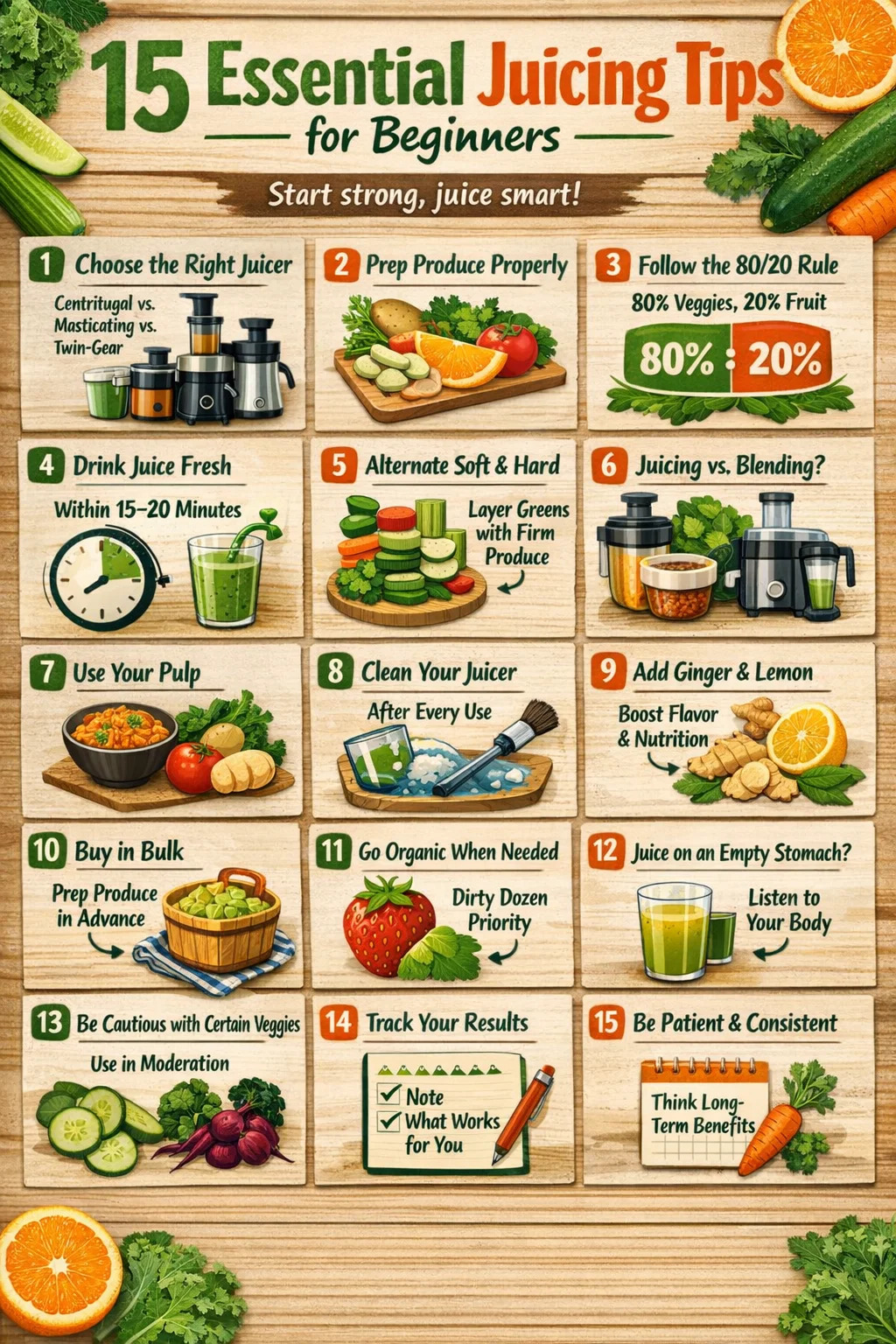
If you just bought your first juicer and you're not sure where to start, here's the bottom line: start with simple green and fruit combinations, always drink your juice within 15–20 minutes of making it, and clean your juicer immediately after every use. Those three habits alone will put you ahead of most beginners who quit within the first month because their juice tastes off, they feel overwhelmed, or their machine smells like last Tuesday's celery.
Everything else — the advanced techniques, the nutrition stacking, the produce shopping strategies — builds on that foundation. The 15 tips below cover the full picture, from picking the right juicer to maximizing what ends up in your glass.
Choose the Right Juicer Before You Buy Anything Else
The single biggest mistake beginners make is purchasing the wrong type of juicer for their lifestyle. There are three main categories, and they are not interchangeable.
Centrifugal Juicers
These are the most widely sold juicer models in big-box stores. They use a fast-spinning metal blade to shred produce and spin the juice out through a mesh filter. They're fast — most can process a whole apple in under 10 seconds — and they're typically the most affordable option, ranging from $50 to $200. The tradeoff is that the high-speed spinning generates heat and introduces air into the juice, which accelerates oxidation. Studies on juice oxidation show that centrifugally extracted juice can lose a measurable percentage of its vitamin C content within 30 minutes if left exposed to air. For someone who wants a quick morning juice and drinks it immediately, centrifugal works fine.
Masticating (Cold Press) Juicers
A masticating juicer uses a slow-turning auger that crushes and presses produce rather than shredding it. The slower process — typically 40 to 80 RPM compared to 3,000 to 16,000 RPM in centrifugal models — produces less heat and less foam. The resulting juice is denser, often darker in color, and generally contains more enzymes and nutrients. Cold press juicers also handle leafy greens like spinach, kale, and wheatgrass far more efficiently. A masticating juicer can extract up to 30% more juice from leafy greens than a centrifugal model. The downside is cost ($150 to $500+) and prep time, since the feed chute is narrower and ingredients usually need to be cut smaller.
Twin-Gear (Triturating) Juicers
Twin-gear juicers are the top of the line. They use two interlocking gears that work together to grind and press produce at extremely low speeds. They handle every type of produce exceptionally well, including wheatgrass, pine needles, and even herbs. However, they're also the most expensive ($400 to $1,000+), the slowest to operate, and the most time-consuming to clean. They're not practical for daily beginner use.
Recommendation for beginners: If budget allows, start with an entry-level masticating juicer. If you need speed and simplicity first, a mid-range centrifugal juicer is a perfectly reasonable starting point.
| Juicer Type | Speed | Nutrient Retention | Best For | Price Range |
|---|---|---|---|---|
| Centrifugal | Fast | Moderate | Hard fruits, quick use | $50–$200 |
| Masticating | Slow | High | Greens, daily juicing | $150–$500+ |
| Twin-Gear | Slowest | Highest | All produce, advanced use | $400–$1,000+ |
Prep Your Produce the Right Way Before It Goes Into the Juicer
How you prepare your ingredients before they enter the juicer affects both yield and machine longevity. These aren't optional steps — they directly impact the quality of what you drink and how long your equipment lasts.
- Wash everything, including "pre-washed" bags. Packaged spinach and kale labeled as pre-washed still carry surface bacteria and pesticide residue. Run everything under cold water for at least 20 seconds, and use a produce brush for root vegetables like carrots, beets, and ginger.
- Remove pits and hard seeds. Peach pits, cherry pits, and apricot seeds contain amygdalin, a compound that breaks down into cyanide when crushed. Your juicer's gears will crack these — remove them every time without exception.
- Peel citrus fruits before juicing. Orange, lemon, lime, and grapefruit peels contain volatile oils that taste intensely bitter and can cause digestive upset in large quantities. Peel them, but leave as much white pith as possible — it contains flavonoids with anti-inflammatory properties.
- Cut produce to match your juicer's feed chute size. Forcing oversized pieces into a masticating juicer strains the motor and can cause jamming. Cut apples into quarters, beets into wedges, and large cucumbers into thirds.
- Keep the skin on where possible. Apple skin, cucumber skin, and grape skin contain concentrated antioxidants. As long as the produce is properly washed, there's no reason to peel it.
Follow the 80/20 Rule for Beginner Juice Recipes
One of the most practical frameworks for beginner juicing is the 80/20 rule: 80% vegetables, 20% fruit. This ratio keeps sugar content manageable while ensuring the juice still tastes approachable for someone not yet used to drinking straight vegetable juice.
Pure vegetable juice made entirely from celery, cucumber, and spinach is nutritionally excellent but can taste grassy and flat to new palates. A single green apple in a 16-ounce juice brings brightness and sweetness that makes the whole thing drinkable without significantly spiking the sugar load. A single medium apple contains about 19 grams of natural sugar — spread across a 16-ounce juice alongside a pound of vegetables, that translates to a far lower glycemic impact than a glass of orange juice.
As your palate adjusts — usually within two to three weeks of regular juicing — you can shift toward 90/10 or even pure vegetable combinations. But in the early stages, don't force yourself to drink something you actively dislike. Palatability is what keeps the habit going.
Starter Recipe to Build From
- 4 stalks of celery
- 1 large cucumber
- 2 large handfuls of spinach
- 1 green apple
- 1/2 lemon (peeled)
- 1-inch piece of fresh ginger
This combination yields approximately 14–16 ounces of juice, provides a solid base of potassium, magnesium, and vitamin K, and tastes clean and slightly sweet without being cloying.
Drink Your Juice Fresh — The 20-Minute Window Matters
Fresh juice begins oxidizing the moment it leaves the juicer. Oxidation degrades vitamins, particularly vitamin C and certain B vitamins, and causes the juice to separate and develop a dull, sometimes metallic taste. For maximum nutritional value, drink juice within 15 to 20 minutes of juicing it.
If you must store juice — because you're batch-making for the week or taking it to work — use an airtight mason jar filled completely to the top to minimize air contact, and store it in the coldest part of your refrigerator. Cold-pressed juice stored this way can hold reasonable nutritional value for up to 48 to 72 hours, though it will never match the freshness of juice consumed immediately. Centrifugally extracted juice degrades faster and is best consumed within 24 hours even when properly stored.
Adding a small squeeze of lemon juice to any recipe you plan to store also helps — vitamin C from the lemon acts as a natural antioxidant that slows the degradation of other nutrients in the blend.
Always Alternate Soft and Hard Ingredients While Juicing
The order in which you feed ingredients into a juicer is not arbitrary. Soft or leafy ingredients — spinach, herbs, cucumber — pass through the machine more easily when sandwiched between harder, more fibrous produce. The hard ingredients act like a push mechanism, driving the softer material through the auger or blade more completely.
A practical feeding order for a typical green juice might look like this:
- Start with celery or cucumber (medium-hard, high water content helps lubricate the juicer)
- Add leafy greens next
- Follow with herbs like parsley or mint
- Push through with apple, carrot, or beet
- Finish with another high-water item like cucumber or a wedge of pineapple to flush residue through
This approach increases overall juice yield from leafy greens by ensuring they're fully pressed rather than passing through partially intact. It also reduces how much pulp builds up in the strainer between batches.
Don't Skip the Fiber Conversation — Juicing vs. Blending
Juicing removes most of the insoluble fiber from produce. This is a point of ongoing debate in nutrition circles, and as a beginner, you deserve a clear-eyed explanation rather than marketing spin from either the juicing or the blending camp.
What juicing offers: By removing fiber, a juicer allows micronutrients — vitamins, minerals, antioxidants, enzymes — to enter the bloodstream much more rapidly. For people with compromised digestion or those recovering from illness, this faster absorption can be genuinely beneficial. A 16-ounce green juice can deliver the concentrated micronutrient equivalent of eating several pounds of raw vegetables, which is physically difficult to do in one sitting.
What juicing doesn't offer: Insoluble fiber feeds beneficial gut bacteria, slows sugar absorption, and contributes to satiety. A glass of apple juice — even freshly pressed — won't keep you full the way an apple will. If juicing replaces whole fruits and vegetables entirely rather than supplementing them, the net fiber intake drops.
The practical takeaway for beginners: use your juicer as an addition to a diet that already includes whole produce, not as a replacement for it. Many experienced juicers also blend one meal a day — using a blender to retain fiber — and reserve the juicer for nutrient-dense shots or supplemental drinks.
Use Your Juicer Pulp Instead of Throwing It Away
Most beginner juicers throw away the pulp. This is an expensive habit. Depending on the produce and juicer type, the dry pulp that comes out of the machine still contains soluble fiber, residual nutrients, and flavor compounds. Over the course of a month of daily juicing, a household can produce several pounds of nutrient-dense pulp that simply gets discarded.
Here are the most practical uses for common types of pulp:
- Carrot and beet pulp: Excellent in muffins, veggie burgers, and energy balls. Replace up to 1/3 of the flour in a muffin recipe with carrot pulp for added moisture and fiber.
- Green vegetable pulp (spinach, kale, celery): Stir into soups or broths, mix into scrambled eggs, or combine with ground flaxseed and bake into dehydrated crackers.
- Citrus pulp: Add to salad dressings, mix into yogurt, or fold into homemade granola for a bitter-bright flavor note.
- Apple and pear pulp: Use in oatmeal, smoothies, or as a base for homemade applesauce with added cinnamon and water.
- Compost anything you don't use: If cooking with pulp isn't appealing, composting it returns nutrients to the soil rather than the landfill.
Clean Your Juicer Immediately After Every Single Use
This is non-negotiable. Leaving pulp and juice residue in a juicer for even two to three hours creates conditions for bacterial growth and mold. Plant-based pulp, particularly from sweet produce like carrots, beets, and apples, is a high-sugar, high-moisture environment that microorganisms colonize rapidly at room temperature.
The cleaning process is faster than most beginners expect once you establish a routine. For a typical masticating juicer, the full cleaning process takes about 5 to 7 minutes:
- Disassemble all removable parts immediately after use
- Rinse each part under cold water to remove loose pulp (hot water can bake residue onto surfaces)
- Use the cleaning brush that came with the juicer — or a stiff vegetable brush — to scrub the mesh strainer from the outside in
- Wash all parts with warm soapy water
- Let air dry completely before reassembling to prevent moisture buildup
If you genuinely cannot clean the juicer immediately — say you're juicing before leaving for work — at minimum rinse all parts under cold running water and leave them submerged in cold water until you return. This prevents pulp from drying and hardening, which is the main reason cleaning becomes tedious and time-consuming.
Add Ginger, Turmeric, and Lemon Strategically for Maximum Impact
These three ingredients appear in almost every high-performance juice recipe for good reason, and learning how to use them well will dramatically elevate both the taste and nutritional profile of your juices.
Ginger
Fresh ginger root contains gingerols and shogaols — compounds with documented anti-inflammatory and digestive-support properties. It also adds a sharp, warming heat that gives flat-tasting vegetable juices a noticeable kick. Start with a 1/2-inch piece per 16-ounce juice and increase gradually. More than an inch of raw ginger per glass can be genuinely overwhelming and may cause heartburn in sensitive individuals. Ginger also has natural antimicrobial properties, making it a smart addition to any juice you plan to store.
Fresh Turmeric
Fresh turmeric root (not the powdered spice) runs through most masticating juicers efficiently and provides curcumin, a well-studied compound associated with anti-inflammatory effects. The key point many beginners miss: curcumin has low bioavailability on its own. Pairing turmeric with black pepper — even a small pinch added to the finished juice — significantly increases curcumin absorption. Some studies suggest that piperine (the active compound in black pepper) can increase curcumin bioavailability by up to 2000%. A 1/4-inch piece of fresh turmeric root per juice is a reasonable starting dose.
Lemon
Half a peeled lemon in any juice does four things simultaneously: it brightens the flavor of bitter greens, adds vitamin C, slows oxidation in stored juice, and alkalizes the finished product. Lemon pairs well with virtually every vegetable combination and is one of the cheapest high-impact additions you can make to any juicing routine.
Buy Produce in Bulk and Prep in Advance to Make Juicing Sustainable
One of the main reasons people abandon juicing within the first few weeks is the friction of daily produce shopping and prep. If getting a glass of juice requires a trip to the grocery store first, the habit is unlikely to stick. The solution is weekly batch prepping.
Spend 20 to 30 minutes once a week washing, chopping, and portioning your produce into individual zip-lock bags or containers. Each bag represents one serving. Pull one bag from the fridge in the morning, run it through the juicer, and you're done. The upfront time investment pays off massively in daily convenience.
For produce that browns quickly — apples, pears — store the cut pieces with a squeeze of lemon juice or in cold water. Root vegetables like carrots and beets hold well for 5 to 7 days in the refrigerator after washing and cutting. Leafy greens last longest when stored dry, wrapped in a paper towel inside a sealed bag to absorb excess moisture.
Farmers markets and wholesale stores like Costco often sell large quantities of juicing-appropriate produce at significantly lower per-pound prices than conventional supermarkets. A 5-pound bag of organic carrots at a wholesale store can cost less per serving than a single organic carrot from a boutique grocery.
Understand Which Produce to Buy Organic and Which to Skip
Buying everything organic is ideal but not financially realistic for most people. Since juicing concentrates produce — you're drinking the extracted liquid from multiple pounds of fruits and vegetables — pesticide residue in the juice can also be more concentrated than in whole produce. This makes the organic vs. conventional decision more relevant for juicers than for people eating whole fruits.
The Environmental Working Group publishes an annual "Dirty Dozen" list of the most pesticide-contaminated produce and a "Clean Fifteen" list of the least contaminated. For juicers, prioritizing organic for Dirty Dozen items is a reasonable cost-conscious strategy.
| Buy Organic (High Pesticide Load) | Conventional Is Fine (Low Pesticide Load) |
|---|---|
| Strawberries | Avocados |
| Spinach | Pineapple |
| Kale / Collard Greens | Onions |
| Apples | Cabbage |
| Celery | Frozen sweet peas |
| Grapes | Asparagus |
Don't Juice on an Empty Stomach Without Knowing This First
Many popular juicing guides recommend drinking juice first thing in the morning on an empty stomach, citing faster nutrient absorption. There's some logic to this — without food in the digestive tract, the micronutrients in juice can enter the bloodstream more rapidly. However, for some people, particularly those with acid reflux, sensitive stomachs, or blood sugar regulation issues, drinking juice on an empty stomach causes immediate discomfort.
High-sugar juices — carrot, beet, apple, or straight fruit combinations — can cause a rapid spike in blood glucose when consumed on an empty stomach, which may be followed by an energy crash within 60 to 90 minutes. For people managing blood sugar or those prone to energy fluctuations, pairing juice with a small amount of protein or fat — a handful of nuts, a hard-boiled egg — blunts the glycemic response without negating the benefits of the juice.
Straight green juice with minimal fruit (celery, cucumber, leafy greens, lemon) is far gentler on an empty stomach and has a much lower glycemic impact. This is one reason why green juice is the traditional choice for early-morning consumption in most structured juicing programs.
Approach Juice Cleanses with Realistic Expectations
If you bought a juicer specifically to do a juice cleanse, you deserve an honest explanation of what a cleanse will and won't do. Juice cleanses — periods of 1 to 5 days where only juice is consumed — are popular in the wellness industry, but the clinical evidence for many of their claimed benefits is limited.
What a short-term juice cleanse may actually do:
- Provide a period of reduced caloric intake, which may produce short-term weight loss (mostly water and glycogen)
- Increase intake of micronutrients, particularly if the prior diet was low in fruits and vegetables
- Prompt a behavioral reset that encourages healthier eating habits afterward
- Reduce bloating and digestive discomfort temporarily for some people
What a juice cleanse will not do:
- Detoxify the liver or kidneys in any meaningful clinical sense — the liver and kidneys perform this function continuously and do not require juice to assist them
- Produce lasting weight loss without corresponding changes to regular dietary patterns
- Replace the need for adequate dietary protein and fat over extended periods
If you want to try a cleanse, a 1-day format is a low-risk way to experience it without significant nutritional disruption. Longer cleanses should be approached with input from a healthcare provider, particularly for anyone with diabetes, kidney disease, or a history of eating disorders.
Track What You Juice to Identify What Works for Your Body
Most people who stick with juicing long-term develop a small repertoire of 3 to 5 recipes they return to consistently. Getting there requires some experimentation, and the only way to learn from that experimentation is to track it.
Keep a simple juicing log — even a basic notes app entry — that records what you juiced, how much you drank, and how you felt in the hour or two afterward. Some people find that high-beet juices give them strong, sustained energy; others find them too sweet or notice digestive changes. Some people thrive on straight green juice in the morning; others find it leaves them hungry and lightheaded. Your body's response to specific ingredient combinations is individual and cannot be reliably predicted from general guidelines alone.
After four to six weeks of tracking, patterns emerge: which combinations give you energy, which ones sit heavily, which ones you actually look forward to drinking. That information is more valuable than any recipe you'll find online, because it's calibrated to your specific physiology.
Know the Produce You Should Use Sparingly in Your Juicer
Not everything in the produce section belongs in a juicer in large quantities. Some ingredients are powerful in small doses and become problematic at higher volumes; others can damage your machine or produce juice that's unsafe to drink.
- Rhubarb: The stalks contain oxalic acid in concentrations that can stress the kidneys when consumed in large quantities as juice. A small amount alongside other produce is fine, but never juice large volumes of rhubarb on its own. The leaves are toxic and must never be juiced.
- Raw beets in large amounts: Beet juice is among the most nutritionally potent things you can put through a juicer — high in nitrates, folate, and betalain antioxidants — but consuming more than 8 ounces of straight beet juice daily can cause beeturia (pink or red urine), temporary digestive changes, and potentially affect blood pressure in people on certain medications. Keep beet juice to no more than 4 ounces per serving until you know how your body handles it.
- Cruciferous vegetables in very high volumes: Broccoli, cauliflower, and Brussels sprouts in concentrated juice form contain goitrogens — compounds that can interfere with thyroid function when consumed in very large amounts. Moderate amounts as part of a varied juice are fine; making 16-ounce straight broccoli juice daily is not advisable.
- Bananas and avocados: These simply don't juice. They have almost no free liquid content and will jam most juicers. Use them in a blender instead.
- Coconut meat: Unless you have a heavy-duty commercial juicer, hard coconut meat will strain or damage the motor. Coconut water, however, works perfectly as a base added directly to the finished juice.
Give Yourself a Realistic Timeline Before Judging Results
People often expect juicing to produce dramatic changes within a week, and when that doesn't happen, they stop. The reality is that dietary changes — even genuinely beneficial ones — take time to manifest in ways that are visible or clearly felt.
A more realistic timeline looks like this:
- Week 1–2: Adjustment period. Your palate gets used to green juice flavors. You may notice increased hydration from the high water content of produce. Some people experience mild digestive changes as fiber intake patterns shift.
- Week 3–4: Many consistent juicers report improved energy levels and better skin clarity. These are the benefits most commonly cited in anecdotal accounts, and they're plausible given the increased micronutrient intake.
- Month 2–3: Established habits take hold. Recipe preferences become clearer. The machine is no longer unfamiliar. Juicing begins to feel like a normal part of the morning rather than a chore.
Juicing is not a shortcut — it's a tool. The people who get lasting value from a juicer are those who integrate it into a broader pattern of eating well, moving regularly, and sleeping enough. Used in that context, a good juicer is one of the most versatile and practical kitchen investments a health-conscious person can make.