
 英语
英语 中文简体
中文简体

Content
- 1 The Direct Answer: It Depends on Your Juicer Type
- 2 Why Orange Peel Is the Central Problem
- 3 Centrifugal Juicers and Oranges: Always Peel First
- 4 Masticating (Cold Press) Juicers and Oranges: Same Rule, Different Reasons
- 5 Citrus Juicers: The One Machine Where You Don't Peel
- 6 Orange Juicer Comparison: Which Machine Gets You the Best Results
- 7 The Best Orange Varieties for Juicing
- 8 How Much Juice Does One Orange Produce?
- 9 Storing Fresh Orange Juice After Juicing
- 10 Orange Juice Combinations: What Pairs Well in a Juicer
- 11 Common Mistakes People Make When Juicing Oranges
The Direct Answer: It Depends on Your Juicer Type
You should not put whole, unpeeled oranges straight into a centrifugal or masticating juicer. The peel of an orange contains high concentrations of d-limonene and other bitter compounds that will make the juice nearly undrinkable. However, if you own a dedicated citrus juicer or a citrus press attachment, you can halve the orange and press it directly — peel and all — because those machines are specifically engineered to extract juice from the flesh while leaving the peel compounds behind.
The confusion around this question comes from the fact that "juicer" means different things to different people. A centrifugal juicer, a cold press masticating juicer, a citrus reamer, and a hydraulic press all process oranges differently. The machine sitting on your counter determines whether you peel first or not — and getting this wrong will either ruin your juice, damage your machine, or both.
This article walks through every juicer type, what happens when you put oranges in each one, and the exact preparation steps that get you the best-tasting, most nutritious orange juice possible.
Why Orange Peel Is the Central Problem
Before getting into machine-specific advice, it helps to understand exactly what is in orange peel and why it matters so much for juice quality.
D-Limonene: The Bitter Compound in Orange Skin
Orange peel contains oil glands packed with d-limonene — a terpene that gives the peel its sharp, resinous aroma. In concentrated form, d-limonene makes up approximately 94–97% of cold-pressed orange peel oil. This compound is useful as a cleaning solvent and flavoring agent in small doses, but when extracted into juice in quantity, it creates an intensely bitter, almost medicinal flavor that overwhelms the natural sweetness of the orange flesh.
A single medium orange (approximately 130g) contains roughly 3–4ml of peel oil. When a centrifugal juicer shreds through the peel at 10,000 RPM, it ruptures those oil glands and forces d-limonene directly into the juice stream. The result is a glass of juice that smells sharp and tastes bitter from the first sip.
Limonin: The Delayed Bitterness Compound
Orange peel and the white pith beneath it also contain limonin precursors. When these compounds come into contact with acidic orange juice, they convert to limonin — one of the most bitter naturally occurring substances known, detectable by the human palate at concentrations as low as 6 parts per million. This is why orange juice made with peel included does not just taste bitter immediately — it actually gets more bitter over the first 30 minutes as limonin continues to form.
The White Pith Layer
Between the outer colored peel (the zest layer) and the fruit segments lies the white pith — the spongy, pale layer that clings to the fruit. The pith is extremely high in naringin, another bitter flavonoid. While naringin has been studied for its antioxidant and anti-inflammatory properties, in juice it produces a strong bitterness that most people find unpleasant. The pith also contains no meaningful juice — it is almost entirely fiber and air pockets — so leaving it on contributes bitterness with zero juice benefit.
Centrifugal Juicers and Oranges: Always Peel First
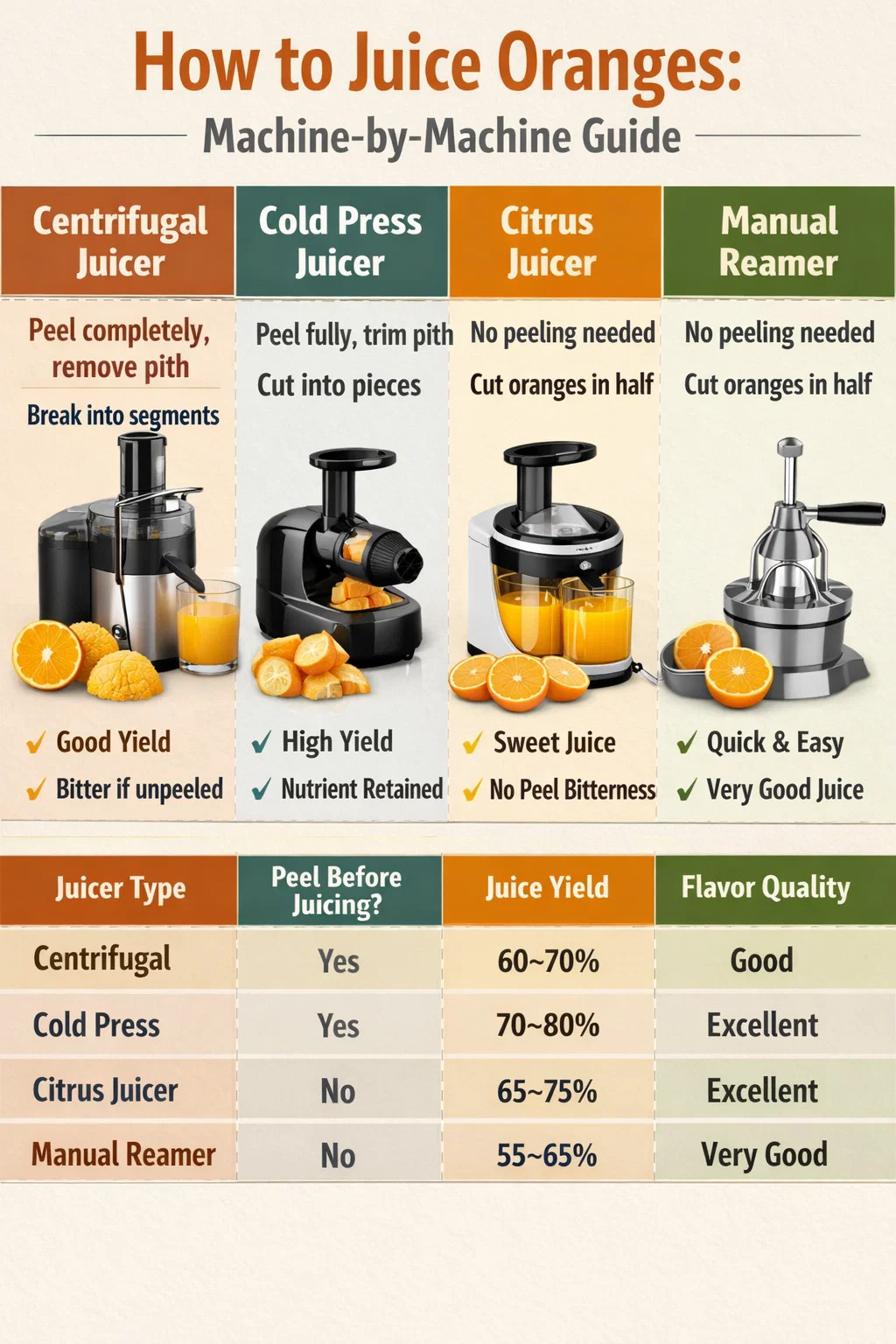
Centrifugal juicers — the most common type found in home kitchens — use a rapidly spinning shredder disc paired with a mesh filter basket. They are fast, affordable, and effective for many fruits and vegetables. Oranges, however, require specific preparation.
What Happens If You Put a Whole Orange In
If you drop a whole, unpeeled orange into a centrifugal juicer's feed chute, several things happen simultaneously. The shredder disc tears through the outer peel, rupturing the oil glands and releasing d-limonene into the juice. The pith is shredded and its bitter compounds are mixed throughout. The seeds — which oranges often contain in significant numbers — are ground up and can contribute additional bitter flavors. The result is juice that experienced juicers universally describe as undrinkable without significant dilution or sweetening.
Beyond taste, the thick orange peel can also cause feed chute jams, particularly in lower-powered centrifugal juicers. Models rated at 150–250 watts may struggle with the resistance of a whole orange, generating heat and motor strain.
The Right Way to Prepare Oranges for a Centrifugal Juicer
Follow these steps for clean, sweet orange juice from a centrifugal juicer:
- Peel the orange completely, removing all outer colored skin
- Remove as much of the white pith as practical — a thin layer remaining is acceptable, but thick pith sections should be trimmed away
- Break the orange into segments or halve it to fit the feed chute width
- Feed segments through at a moderate pace — do not force them down with hard pressure
- Drink the juice within 15–20 minutes for peak flavor before oxidation begins
You do not need to remove orange seeds before juicing in a centrifugal machine — the mesh filter basket catches seed fragments. However, removing large seeds reduces the amount of bitter seed compounds introduced into the juice stream.
Masticating (Cold Press) Juicers and Oranges: Same Rule, Different Reasons
Masticating juicers — also called cold press juicers or slow juicers — use a rotating auger to crush and press produce rather than shredding it at high speed. They operate at 40–80 RPM compared to the 6,000–14,000 RPM of centrifugal models, which preserves more nutrients and enzymes by generating less heat. Many masticating juicer users wonder if the slower, gentler action means they can put whole oranges straight in.
Why You Still Need to Peel for Cold Press Juicers
The slow speed does not reduce the bitterness problem — in some respects it makes it worse. A masticating auger applies sustained, high pressure to every part of the orange it contacts. This pressure is extremely effective at squeezing every drop of liquid out of cell structures, including the oil cells in the peel. Cold press extraction of orange peel oil is actually more thorough than centrifugal processing because the slow squeeze gives oil more time to migrate into the juice stream.
Additionally, whole unpeeled oranges can jam single-auger masticating juicers. The hard, rubbery texture of orange peel combined with the round shape of the fruit does not feed smoothly into the auger channel. Many users report that whole oranges spin against the auger rather than being pulled in, stalling the machine.
Can You Leave a Thin Layer of Pith on for a Cold Press Juicer?
A very thin residual layer of white pith — the kind that naturally clings to segments after peeling — is fine and unavoidable. What you want to avoid is deliberately leaving thick sections of pith attached. In a masticating juicer, trim the peel down to where the flesh is just visible, then juice. The minor pith residue on peeled segments will not meaningfully affect flavor.
Citrus Juicers: The One Machine Where You Don't Peel
A dedicated citrus juicer — whether electric or manual — is the only common juicing machine where you put the orange in without peeling it first. These machines are specifically designed around the anatomy of citrus fruit.
How a Citrus Juicer Works
A citrus juicer works by pressing the cut face of a halved orange down onto a ridged reamer cone. The cone's ridges penetrate the flesh and break open the juice sacs, while the pressure is applied inward (toward the center of the fruit) rather than outward through the peel. The peel acts as a structural cup that holds the fruit in place while the juice is extracted through the flesh side. Oil glands in the peel are never ruptured because the machine never contacts the outer skin.
This is why citrus juicers — from simple hand reamers to automatic electric models like the Breville Citrus Press — consistently produce sweeter, cleaner-tasting juice than centrifugal juicers processing peeled oranges. The peel is present but irrelevant to the juice stream.
Electric Citrus Juicers vs. Manual Reamers
Both work on the same principle, but there are practical differences worth knowing:
- Manual reamers give you tactile control over pressure — you can adjust how hard you press to limit the amount of pith contact. They produce excellent juice but require more physical effort for large batches.
- Electric citrus juicers with a spinning reamer automate the rotation but apply consistent (sometimes excessive) pressure. Pressing too hard on an electric reamer can crack the peel and introduce small amounts of peel oil.
- Lever-arm citrus presses (like the commercial-style hinged models) apply even, downward pressure and are ideal for high-volume juicing. They virtually never introduce peel bitterness.
The Right Way to Use a Citrus Juicer
Even with a dedicated citrus juicer, there are small preparation steps that improve the final result:
- Bring oranges to room temperature before juicing — cold oranges from the refrigerator yield up to 20–30% less juice than room-temperature fruit because cold temperatures cause the juice sacs to contract
- Roll the orange firmly on a hard surface under your palm for 10–15 seconds before cutting — this breaks down internal membranes and releases significantly more juice
- Cut the orange across its equator (not pole to pole) — this exposes more juice sacs to the reamer
- Press firmly but do not grind the peel against the reamer at the end of each squeeze
- Strain through a fine mesh sieve if you prefer pulp-free juice
Orange Juicer Comparison: Which Machine Gets You the Best Results
The table below compares the four main juicer types for orange processing, covering preparation requirements, juice yield, flavor quality, and typical cleanup time.
| Juicer Type | Peel Before Juicing? | Typical Juice Yield | Flavor Quality | Cleanup Time |
|---|---|---|---|---|
| Centrifugal juicer | Yes — fully peel | 60–70% of fruit weight | Good when peeled correctly | 5–10 minutes |
| Masticating (cold press) | Yes — fully peel | 70–80% of fruit weight | Excellent; more nutrients retained | 10–15 minutes |
| Dedicated citrus juicer | No — halve only | 65–75% of fruit weight | Excellent; zero peel bitterness | 2–3 minutes |
| Manual hand reamer | No — halve only | 55–65% of fruit weight | Very good with proper technique | Under 1 minute |
The Best Orange Varieties for Juicing
Not all oranges produce the same quality of juice. The variety you choose affects sweetness, acidity, juice yield, and how the juice holds up after extraction.
Valencia Oranges
Valencia oranges are the global standard for commercial orange juice production. Over 90% of all commercially produced orange juice is made from Valencia oranges. They are thin-skinned, high in juice content (typically 45–55% juice by weight), and have an excellent balance of sweetness and acidity. Their juice also holds up well after extraction — it does not develop bitterness as quickly as some other varieties. Valencias are available from late spring through summer.
Navel oranges are the most widely available variety in supermarkets. They are sweet, easy to peel, and produce good juice — but with one important caveat. Navel orange juice develops bitterness within 30 minutes of extraction due to limonin formation, which accelerates faster in navels than in most other varieties. Navel orange juice should be consumed immediately after juicing and should never be stored. This is why commercial juicers never use navels for bottled juice.
Blood Oranges
Blood oranges produce a striking deep red to ruby juice due to anthocyanin pigments — the same compounds found in berries and red cabbage. The flavor is distinctly different from standard oranges: raspberry and citrus notes combine to create a complex, slightly tart juice. Blood oranges are lower in yield than Valencias but produce some of the most flavorful fresh-squeezed juice available. They work beautifully in both centrifugal and masticating juicers when peeled.
Cara Cara Oranges
Cara Cara oranges are a variety of navel orange with pink-red flesh and a notably sweeter, lower-acid flavor profile. They contain less limonin precursor than standard navels, meaning their juice develops bitterness slightly more slowly — though still faster than Valencia. They are excellent for fresh juice consumed within 20 minutes.
Mandarin Oranges and Clementines
Mandarins and clementines can be juiced in any machine, but their small size and loose, easily removed peels make them ideal for hand reamers and citrus juicers. In a centrifugal or masticating juicer, peel them completely before processing. Their juice is sweeter and less acidic than standard orange juice, making them excellent for blending with more tart varieties.
How Much Juice Does One Orange Produce?
Knowing how many oranges to prepare saves time and prevents mid-session interruptions. Juice yield varies significantly based on orange variety, size, ripeness, temperature, and juicer type.
- A medium Valencia orange (approximately 130g) yields about 60–80ml of juice in a centrifugal juicer and 70–90ml in a masticating juicer
- A standard 8oz (240ml) glass of orange juice requires approximately 3–4 medium oranges
- Room-temperature oranges consistently yield 20–30% more juice than refrigerated ones
- Rolling the orange before cutting increases yield by an additional 10–15% regardless of juicer type
- Heavier oranges with thin, smooth skin yield more juice than lighter oranges with thick, pitted skin
For a family of four wanting a glass each at breakfast, budget 12–16 medium oranges. If you are using a masticating juicer and room-temperature Valencias, the lower end of that range (12) is likely sufficient.
Storing Fresh Orange Juice After Juicing
Fresh-squeezed orange juice degrades quickly. Understanding the timeline helps you decide when to juice and how to store the result.
Oxidation and Vitamin C Loss
The moment orange juice is exposed to air, oxidation begins. Vitamin C (ascorbic acid) is one of the first casualties — freshly squeezed orange juice loses approximately 25% of its vitamin C content within 30 minutes at room temperature. After two hours at room temperature, the loss reaches 50% or more. Refrigeration slows but does not stop this process.
As discussed earlier, navel orange juice becomes progressively more bitter after extraction due to limonin formation. Navel orange juice stored in the refrigerator for more than 2–3 hours becomes noticeably bitter. Valencia orange juice, by contrast, can be refrigerated in an airtight container for up to 24 hours with acceptable flavor retention — though same-day consumption is always preferable.
Best Practices for Storing Fresh Orange Juice
- Store in a glass container with an airtight lid — plastic containers allow oxygen permeation and can leach compounds into acidic juice
- Fill the container as close to the top as possible to minimize headspace air exposure
- Refrigerate at or below 4°C (39°F) immediately after juicing
- For Valencia juice: consume within 24 hours for best flavor; acceptable up to 48 hours
- For navel orange juice: consume within 30–60 minutes — refrigeration does not solve the limonin bitterness problem
- Do not freeze fresh orange juice — freezing destroys the volatile aroma compounds that give fresh juice its characteristic bright flavor, and the juice tastes flat after thawing
Orange Juice Combinations: What Pairs Well in a Juicer
Orange juice is one of the most versatile bases for mixed vegetable and fruit juices. The natural sweetness and acidity of orange helps balance earthier or more bitter ingredients. These combinations work well in both centrifugal and masticating juicers when the orange is properly peeled.
- Orange + carrot: A classic pairing. Carrot adds beta-carotene and a mild sweetness. Use a 2:1 ratio of orange to carrot for a balanced flavor. This combination is among the most popular cold-press juice blends globally.
- Orange + ginger: A 2-inch piece of fresh ginger per 4 oranges adds anti-inflammatory gingerols and a warming spice note. Peel the ginger before feeding into a masticating juicer; most centrifugal juicers can handle unpeeled ginger in small pieces.
- Orange + beet: Beet juice is intensely earthy and benefits from orange's sweetness. A ratio of 3 oranges to 1 medium beet produces a vivid, complex juice. Always trim the beet root tail and crown before juicing.
- Orange + pineapple: Both fruits have high acid content, so this combination works best for people who enjoy a tart, bright juice. Pineapple contains bromelain enzymes that help improve the texture of the final juice.
- Orange + turmeric: Fresh turmeric root (about 1 inch per 4 oranges) adds curcumin and a mildly peppery flavor. It stains equipment and surfaces intensely — clean your juicer immediately after use when processing turmeric.
Common Mistakes People Make When Juicing Oranges
Even experienced juicer users make these errors regularly. Correcting them immediately improves the quality of every glass.
- Juicing straight from the refrigerator: Cold oranges yield significantly less juice. Take oranges out 20–30 minutes before juicing, or submerge them in warm (not hot) water for 5 minutes to bring them to room temperature quickly.
- Leaving too much pith on peeled segments: Even after peeling, segments often retain thick pith sections at the poles of the orange. Trim these away — they contribute bitterness without adding any juice.
- Using navel oranges for stored juice: Navel oranges are excellent for immediate consumption but completely unsuitable for making juice in advance. Switch to Valencias for any juice that will be stored even briefly.
- Overfilling the feed chute: Forcing multiple orange segments into the chute simultaneously causes uneven extraction and can jam the machine. Feed segments one at a time at a consistent pace.
- Not cleaning the juicer immediately: Orange juice's acidity causes residue to bond aggressively to plastic and metal surfaces as it dries. Rinse all components within 10 minutes of finishing — a quick rinse now saves 20 minutes of scrubbing later.
- Discarding the pulp without consideration: Orange pulp from a centrifugal or masticating juicer is rich in pectin and soluble fiber. It can be added to smoothies, baked into muffins, mixed into salad dressings, or composted. Approximately 40–50% of an orange's total fiber content ends up in the pulp during juicing.