
 英语
英语 中文简体
中文简体

Content
- 1 The Best Fruit Juicer Recipes Start With the Right Combinations
- 2 Apple-Ginger-Carrot: The Foundation Juicer Recipe
- 3 Citrus-Pineapple-Turmeric: The Anti-Inflammatory Juicer Recipe
- 4 Watermelon-Mint-Lime: The High-Yield Summer Juicer Recipe
- 5 Green Fruit Juicer Recipes: How to Make Them Taste Good
- 6 Juicer Type Comparison: Which Recipes Work Best in Which Machine
- 7 Seasonal Fruit Juicer Recipes Worth Making Throughout the Year
- 8 How to Store Fresh Juice Without Losing Nutritional Value
- 9 Nutritional Comparison of Common Fruit Juicer Recipes
- 10 Practical Tips for Getting More From Your Juicer Every Day
- 11 Common Mistakes in Fruit Juicer Recipes and How to Fix Them
The Best Fruit Juicer Recipes Start With the Right Combinations
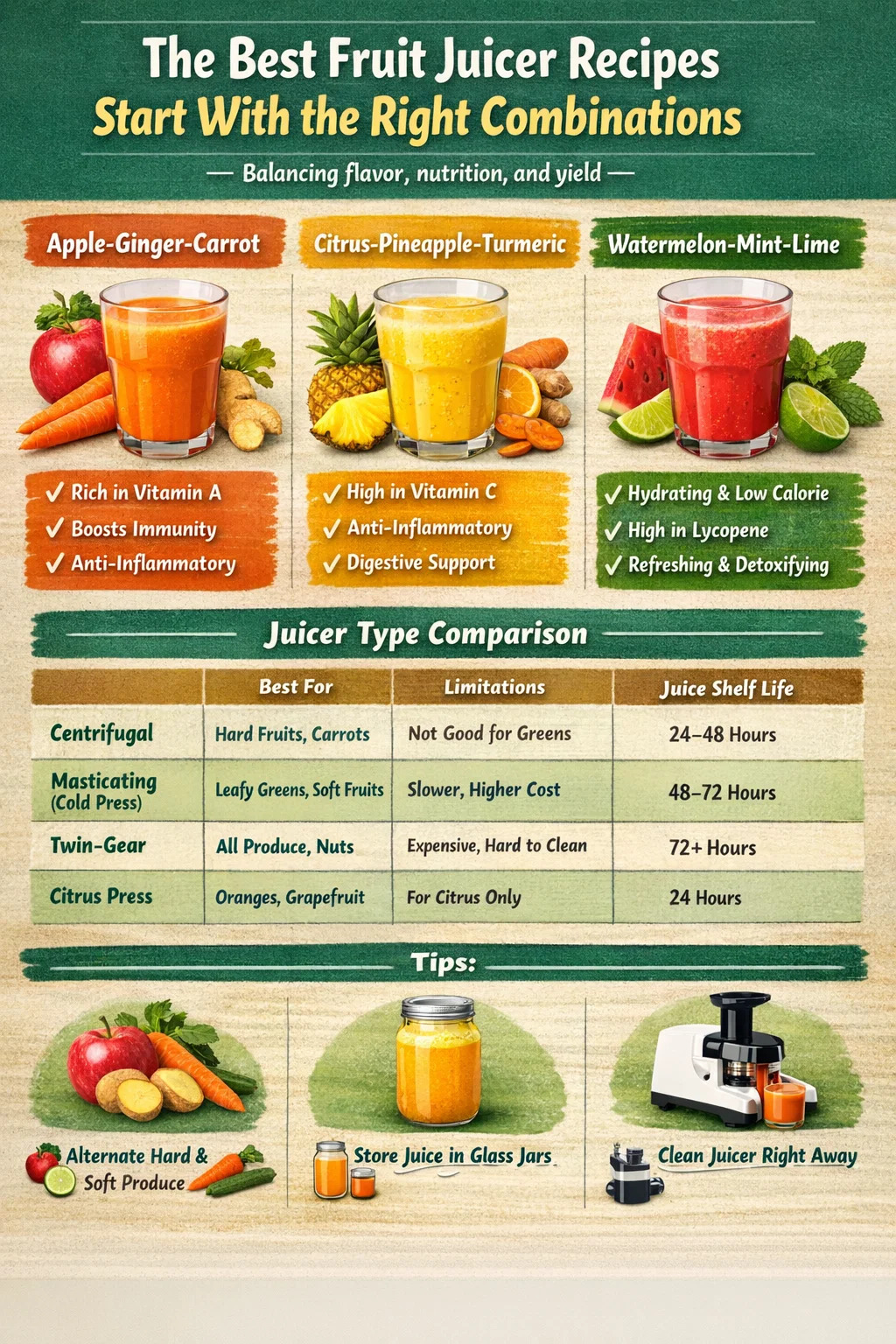
If you want results from your juicer, the single most important factor is how you combine your ingredients. A citrus-heavy juice without a green base tastes sharp and one-dimensional. A purely vegetable juice without fruit often tastes flat. The sweet spot — in terms of flavor, nutrition, and color — comes from building recipes around a dominant fruit base, one or two supporting ingredients, and a finishing element like ginger, lemon, or mint.
The three recipes most consistently rated highest by home juicers are: apple-ginger-carrot, citrus-pineapple-turmeric, and watermelon-mint-lime. Each of these works because they balance sweetness, acidity, and a sharp aromatic element. They also yield high volumes of juice per pound of produce — which matters when you're feeding fruit into a juicer every morning.
This guide covers the full picture: which recipes extract the most juice, how to adapt them to different juicer types, what nutritional value each combination provides, and how to store the results without losing potency.
Apple-Ginger-Carrot: The Foundation Juicer Recipe
Apple-ginger-carrot is the most versatile entry point for anyone new to fruit juicer recipes. The apple provides a neutral sweet base that complements almost anything. Carrot adds body and beta-carotene. Fresh ginger cuts through the sweetness and adds warmth that makes the drink feel less like dessert and more like something functional.
A standard single-serve ratio that works well in both centrifugal and masticating juicers:
- 2 medium apples (preferably Fuji or Gala — sweeter varieties reduce the need for added sugar)
- 3 medium carrots, scrubbed but not peeled
- 1-inch piece of fresh ginger root
- Optional: half a lemon, peeled, for brightness
This combination yields approximately 280–320ml of juice from roughly 600g of produce — a solid extraction rate for a cold-press juicer. Centrifugal juicers will extract slightly less and produce a thinner texture due to higher heat and faster spin speeds.
The nutritional profile per serving is meaningful: approximately 120 calories, 28g of natural sugars, 600% of the daily recommended intake of vitamin A from the carrots alone, and a measurable dose of gingerols from the ginger — compounds associated with reduced inflammation in several clinical studies. This is not a low-sugar recipe, but the fiber void left by juicing is partially offset by the micronutrient density.
One technique that improves this recipe significantly: alternate hard ingredients (carrot) with soft ones (apple) when feeding your juicer. Hard produce drives soft produce through the mechanism more efficiently, reducing the chance of clogging and improving total yield by roughly 10–15% compared to feeding all of one type before the other.
Citrus-Pineapple-Turmeric: The Anti-Inflammatory Juicer Recipe
This recipe became widely popular in wellness circles around 2018–2019 and has stayed prominent because it genuinely delivers both in flavor and functional ingredients. Orange and pineapple carry bromelain — an enzyme with documented anti-inflammatory properties — while turmeric adds curcumin, its primary active compound. The combination is one of the few fruit juicer recipes where the health claims have reasonable scientific backing.
Recipe for two servings:
- 3 large oranges, peeled
- 1 cup fresh pineapple chunks (approximately 150g)
- 1-inch piece fresh turmeric root (or ½ tsp ground turmeric as a fallback)
- A pinch of black pepper — this measurably increases curcumin absorption by up to 2,000% according to research published in the journal Planta Medica
- Optional: half a grapefruit for more bitterness and added vitamin C
Important note for juicer selection: citrus-heavy recipes perform best in a dedicated citrus press or a masticating juicer with a citrus attachment. Centrifugal juicers struggle with the fibrous white pith in citrus and often introduce a bitter aftertaste from over-processing the rind. If you only have a centrifugal juicer, peel the citrus carefully and remove as much white pith as possible before juicing.
Turmeric root stains everything it touches — cutting boards, your hands, your juicer's plastic components. Run a chunk of apple or carrot through the juicer immediately after the turmeric to flush residue through the mechanism before it sets. A dilute solution of baking soda and water removes turmeric stains from most surfaces if applied within 30 minutes.
This recipe produces a vibrant orange-gold color that deepens with turmeric concentration. Served cold, it has a warming finish that seems contradictory but is the quality most people remember about it. One 240ml serving contains approximately 110 calories, 22g of natural sugar, and over 100% of the daily recommended vitamin C.
Watermelon-Mint-Lime: The High-Yield Summer Juicer Recipe
Watermelon is about 92% water by weight, which makes it one of the most efficient fruits you can put through a juicer. A single medium watermelon yields 4–6 liters of juice with minimal effort. The challenge with watermelon juice is that it tastes thin on its own — essentially sweetened water — so the recipe depends entirely on what you add to it.
The classic combination:
- 4 cups seedless watermelon, rind removed (approximately 600g)
- 1 lime, peeled
- 8–10 fresh mint leaves (add these last and run them through quickly — they tend to jam centrifugal juicers)
- Optional: half a cucumber, which adds volume and a clean vegetal note without sweetness
Watermelon juice separates quickly — within 5–10 minutes of juicing, the denser red pigment settles to the bottom. This is normal and not a sign of spoilage. Stir or shake before drinking. If separation bothers you aesthetically, blend the cucumber separately and add it in, or use a masticating juicer, which processes more slowly and produces a more emulsified result.
Watermelon is one of the richest dietary sources of lycopene — a carotenoid with antioxidant properties. Interestingly, the concentration of lycopene in watermelon juice is higher than in fresh-cut watermelon because juicing ruptures cell walls and releases more of the compound. One 350ml serving provides approximately 15–20mg of lycopene, compared to the roughly 6mg found in a typical tomato.
This recipe is also exceptionally low in calories — around 75–90 per 350ml serving — which makes it a legitimate option for people monitoring caloric intake while still using their juicer regularly.
Green Fruit Juicer Recipes: How to Make Them Taste Good
Green juice has a reputation problem. Most people who try it for the first time make the mistake of going too heavy on leafy greens before their palate has adjusted. The result tastes like liquid lawn clippings, they pour it down the sink, and they don't try again.
The correct approach is to start with a fruit-heavy ratio and gradually increase the green content over two to three weeks. A good starting ratio for someone new to green juice:
- 70% fruit (apple, pear, or pineapple as the base)
- 20% mild greens (cucumber, celery, or romaine — not kale or spinach to start)
- 10% flavor modifiers (lemon, ginger, or mint)
A concrete recipe that works at this ratio:
- 2 green apples
- 1 cucumber
- 2 stalks of celery
- 1 lemon, peeled
- 1-inch piece of ginger
Green apple is specifically better than red apple in these recipes because its tartness bridges the vegetal and fruit elements. Red apple creates a sweetness gap that makes the green ingredients taste more pronounced by contrast, which most beginners find unpleasant.
Once you're comfortable with this recipe, the progression toward more greens-heavy fruit juicer recipes is straightforward: swap the cucumber for half a head of romaine after a week, then add a handful of spinach (which has almost no taste in juice) the week after that. Kale — the most nutritionally dense green — is best introduced last because of its stronger flavor profile. A masticating juicer handles leafy greens dramatically better than a centrifugal model; if green juice is a priority, this is the machine type to prioritize.
Juicer Type Comparison: Which Recipes Work Best in Which Machine
Not all fruit juicer recipes are equally suited to every type of juicer. The machine you own determines which ingredients you can use effectively, how much juice you'll extract, and how long the juice will stay fresh after extraction. Understanding these differences prevents frustration and wasted produce.
| Juicer Type | Best For | Limitations | Juice Shelf Life | Price Range |
|---|---|---|---|---|
| Centrifugal | Hard fruits, carrots, apples, cucumbers | Poor with leafy greens, wheatgrass, citrus pith | 24–48 hours refrigerated | $50–$200 |
| Masticating (cold press) | Leafy greens, citrus, soft fruits, wheatgrass | Slower process, higher price point | 48–72 hours refrigerated | $150–$500+ |
| Twin-gear (triturating) | Everything including fibrous produce and nuts | Expensive, time-consuming to clean | 72+ hours refrigerated | $300–$700+ |
| Citrus press | Oranges, lemons, limes, grapefruit | Single-use — cannot process other produce | 24 hours refrigerated | $20–$80 |
For someone who wants to follow a wide variety of fruit juicer recipes without restriction, a masticating juicer is the most practical choice. The Omega J8006 and Hurom H-AA are two models that consistently perform well across recipe types and have enough market longevity that replacement parts are readily available.
Seasonal Fruit Juicer Recipes Worth Making Throughout the Year
Using produce at its seasonal peak makes a significant difference in juice quality. Fruit juiced at peak ripeness yields more liquid per pound, requires less additional sweetener, and contains higher concentrations of the vitamins and phytochemicals you're actually after. Out-of-season produce, even when it looks acceptable, is often starchier and lower in water content.
Spring and Summer Recipes
Strawberry-rhubarb juice is one of the most underrated spring combinations. The tartness of rhubarb (technically a vegetable, but used as fruit in cooking) pairs with the sweetness of early-season strawberries in a way that needs almost no additional flavoring. Use 2 cups of strawberries to every 2 stalks of rhubarb, plus a small apple to help carry the liquid through the juicer mechanism. Rhubarb leaves are toxic and must be removed entirely before juicing. Only the stalks go into the machine.
Peach-nectarine-basil is a summer-specific recipe that reads unusual but works because the herb complements stone fruit in the same way mint works with watermelon. Use 3 ripe peaches, 2 nectarines, and 4–5 large basil leaves. The result is deeply aromatic and pairs well served over ice with sparkling water added to stretch the volume.
Mango-pineapple-coconut water is not strictly a juicer recipe in the traditional sense — coconut water is added post-extraction to thin the juice, since mango alone produces an extremely thick, pulpy result that can overwhelm some juicers. Run 2 mangos and half a pineapple through the juicer, then mix 1:1 with fresh coconut water. The result is 500ml of something that tastes like a tropical drink without any added sugar.
Autumn and Winter Recipes
Pear-fennel-lemon is a cooler-season combination that most people have never considered. Fennel has a mild anise flavor that softens dramatically when juiced. Use 3 ripe Bartlett pears, half a fennel bulb (fronds included), and one lemon. The fennel fronds yield more juice than the bulb per gram and have a slightly milder flavor — include them if your juicer can handle leafy material.
Apple-pomegranate juice is a winter staple. Pomegranate seeds are difficult for most juicers to process intact — the hard seeds can damage some mechanisms and the bitter white membrane introduces unpleasant tannins. The cleanest method is to extract pomegranate juice by hand (roll the fruit, pierce it, and squeeze into a bowl) then combine it with machine-extracted apple juice in a 1:3 ratio. Pomegranate juice has one of the highest antioxidant concentrations of any commercially available juice — roughly three times that of red wine and green tea, according to research from the University of California.
Spiced citrus with cinnamon and clove makes a warming cold-season juice: 4 blood oranges, 1 ruby grapefruit, 1 lemon, a single clove added directly to the juice after extraction (not put through the juicer), and a pinch of cinnamon stirred in. Blood orange season is short — typically January through March in the Northern Hemisphere — so this recipe has a narrow window, which is part of what makes it worth making when it's available.
How to Store Fresh Juice Without Losing Nutritional Value
Fresh juice oxidizes quickly. Every minute it sits exposed to air, light, or heat, it loses vitamins and changes flavor. Most of the loss happens in the first two to four hours post-extraction, which is why commercially sold cold-pressed juice goes through high-pressure processing (HPP) to extend shelf life — a process that home juicers obviously don't have access to.
Practical storage rules for home-made fruit juicer recipes:
- Use glass containers, not plastic. Glass doesn't leach compounds into acidic juice and doesn't absorb color or odor over time. Mason jars are inexpensive and seal reliably.
- Fill containers to the very top to minimize air space. Even a small air gap accelerates oxidation significantly.
- Add a squeeze of lemon to any recipe that doesn't already contain citrus. The ascorbic acid acts as a mild preservative and slows oxidation.
- Refrigerate immediately after juicing. Room temperature storage, even for 30 minutes, meaningfully accelerates bacterial growth in unpasteurized juice.
- Juice made in a masticating juicer stores better than juice from a centrifugal machine. The lower heat during extraction means less initial oxidation, and the denser, more emulsified result separates more slowly.
- For juice intended to last beyond 48 hours, freezing in ice cube trays and then transferring to a sealed bag is a legitimate strategy. Frozen juice retains most of its nutritional value for up to three months.
Citrus-based recipes degrade faster than apple or carrot-based recipes because the higher acid content and more volatile aromatic compounds break down more readily on contact with oxygen. A citrus-pineapple juice should ideally be consumed within 24 hours. An apple-carrot juice made in a cold-press juicer can still be palatable — though slightly oxidized — at 48 hours.
Nutritional Comparison of Common Fruit Juicer Recipes
Understanding the nutritional differences between recipes helps you choose what to make based on what you actually want to get out of it. The table below compares five standard single-serve (approximately 250ml) juice recipes across key nutritional categories. Figures are approximate and will vary based on produce ripeness and juicer efficiency.
| Recipe | Calories | Natural Sugar (g) | Vitamin C (% DRI) | Notable Compound |
|---|---|---|---|---|
| Apple-Ginger-Carrot | ~115 | 24 | 18% | Beta-carotene, gingerols |
| Citrus-Pineapple-Turmeric | ~105 | 21 | 110% | Curcumin, bromelain |
| Watermelon-Mint-Lime | ~80 | 17 | 22% | Lycopene, citrulline |
| Green Apple-Cucumber-Celery | ~70 | 13 | 15% | Quercetin, apigenin |
| Pomegranate-Apple | ~130 | 28 | 20% | Punicalagins, ellagic acid |
The key takeaway from this comparison is that the citrus-pineapple-turmeric recipe delivers by far the highest vitamin C per serving, while watermelon-mint-lime is the most calorie-efficient option for anyone monitoring intake. Apple-ginger-carrot and pomegranate-apple are higher in natural sugars, which is worth noting for people managing blood glucose levels — though neither is dramatically different from commercially sold orange juice, which averages around 21–24g of sugar per 250ml.
Practical Tips for Getting More From Your Juicer Every Day
The difference between someone who uses their juicer daily for years and someone who puts it at the back of the cupboard after two weeks usually comes down to workflow, not recipe quality. These are the practical habits that keep juicing sustainable.
Prep produce in batches
Washing, cutting, and portioning a week's worth of produce takes about 20–25 minutes. Store the prepped ingredients in labeled containers in the fridge. On a given morning, all you do is open a container and feed it into the juicer. This eliminates the mental overhead that causes most people to skip juicing when they're pressed for time.
Use the pulp — don't discard it
Juicer pulp still contains fiber, color, and flavor. Carrot pulp works in carrot cake and veggie burgers. Apple pulp can go into overnight oats or muffin batter. Citrus pulp adds texture to marinades and salad dressings. Tomato pulp (for those making vegetable juices) can be turned directly into pasta sauce. Using pulp reduces food waste significantly — for a household juicing daily, the pulp from a week of recipes would otherwise represent several pounds of discarded produce per week.
Clean the juicer immediately, not later
Juice residue that dries in a juicer screen takes four to five times longer to clean than residue removed while still wet. Rinse all removable components under running water within five minutes of finishing. The mesh filter basket is the component most people struggle with — a stiff brush (most juicers include one) and cold water, not hot, clears the mesh fastest. Hot water sets protein and fiber residue in the mesh; cold water lifts it.
Start with room-temperature produce for better yield
Cold produce — straight from the fridge — is firmer and yields slightly less juice than room-temperature produce. If you're prepping produce the evening before, take it out of the fridge 15–20 minutes before juicing for a marginally higher yield. This is especially noticeable with citrus: a cold orange yields roughly 10–15% less juice than the same orange at room temperature.
Know which ingredients to peel and which to leave whole
Most root vegetables and thin-skinned fruits — carrots, apples, pears, cucumbers, beets — can go through the juicer unpeeled after washing, and the peel adds nutrients and often improves color. Citrus must be peeled to avoid the bitter pith. Mangos, papayas, and melon rinds should be removed. Pineapple core can go through the juicer — it yields a meaningful amount of juice and the tougher texture helps push softer ingredients through the mechanism. Ginger root can go in unpeeled if it's clean; the peel has the same gingerol content as the flesh.
Common Mistakes in Fruit Juicer Recipes and How to Fix Them
Most problems people encounter when making fruit juicer recipes fall into a small number of categories. Each has a straightforward solution.
- Juice tastes too sweet: Add more acid. A half lemon or lime immediately cuts perceived sweetness without adding sugar. If the recipe doesn't have any bitter element, small amounts of grapefruit, radicchio, or even a small piece of dark green kale fix the balance without being detectable as a single flavor.
- Juice tastes too bitter or sharp: Add apple. Apple is the most effective flavor neutralizer in juicing — a single green or red apple smooths out bitter greens, overly tart citrus, and the earthiness of beet juice. Pear works similarly but adds more body.
- Juice is too thin: Use more carrot, beet, or sweet potato. These root vegetables produce a denser juice that adds body to watery combinations. Alternatively, reducing the ratio of high-water-content fruits like watermelon and cucumber automatically increases concentration.
- Juicer is clogging frequently: You're feeding too much soft produce consecutively. Always alternate hard and soft ingredients. Start and end each session with a hard ingredient (apple, carrot) to push residual soft pulp through the mechanism.
- Juice turns brown quickly: Oxidation from high-surface-area fruit like apple and pear. Add more citrus — the ascorbic acid slows browning visibly. Store in a full, sealed container. If appearance matters, use more beet or carrot to mask the browning with deeper color.
- Recipe tastes flat or one-dimensional: Every successful juice recipe has contrast — sweet against sour, mild against sharp. If something tastes flat, it usually means the recipe is too uniform. Add ginger for heat, lemon for acid, mint for coolness, or turmeric for earthiness. These finishing elements take a juice from acceptable to something you'll want to drink every day.